
AIFlow
AIFlow Update: A Smoother Path to Targeted Outreach
The latest AIFlow update aims to help your team build more targeted automated outreach by offering more diverse data sources and AI-driven lead discovery.
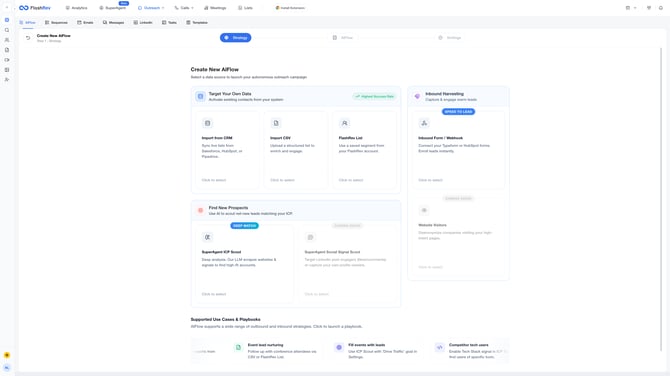
AIFlow now supports three distinct pathways to launch your autonomous outreach, catering to every stage of your sales funnel:
1. Target Your Own Data (Highest Success Rate)
This module is recognized as the most effective path for customer acquisition. Its core advantage lies in activating dormant or existing contact assets within your system, using AI to reach out with surgical precision.
2. Inbound Harvesting (Speed to Lead)
This module focuses on capturing and converting high-intent "Warm Leads" in real-time.
3. Find New Prospects (AI Scouting)
Leverage SuperAgent ICP Scout to proactively scout and discover new leads matching your Ideal Customer Profile (ICP). Using "Deep Match" technology, our LLM scrapes websites and signals to find high-fit accounts you haven't reached yet.
The Brain: AI Pitch Strategy Center
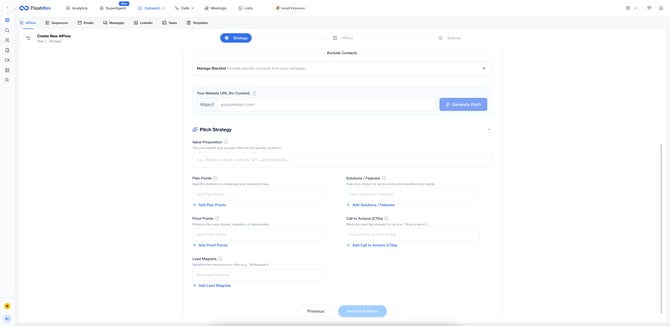
Once a data source is selected, all modes converge in the Pitch Strategy—the "brain" of your AIFlow. The AI customizes communication logic for every contact based on the context you provide:
Website Context Analysis: Simply enter your company's Website URL and click "Generate Pitch.". The AI will automatically crawl and analyze your business background to provide the foundational context for all subsequent content generation.
Six-Dimension Strategy Configuration
The AI guides you through (or auto-generates) these critical pillars to ensure every email carries logical depth:
-
Value Proposition: Clear benefits your product offers to this specific audience (e.g., "Reduce cloud costs by 30% automatically").
-
Pain Points: Precise identification of the specific challenges and business hurdles your prospects face.
-
Solutions / Features: How your product specifically resolves the aforementioned pain points.
-
Proof Points: Case studies, statistics, or testimonials to establish high-trust social proof.
-
Call to Actions (CTAs): Clear conversion goals (e.g., "Book a Demo," "View Document").
-
Lead Magnets: High-value free resources (e.g., "Industry Whitepaper") to significantly increase initial engagement.
Smart Orchestration: High-Precision Email Sequences
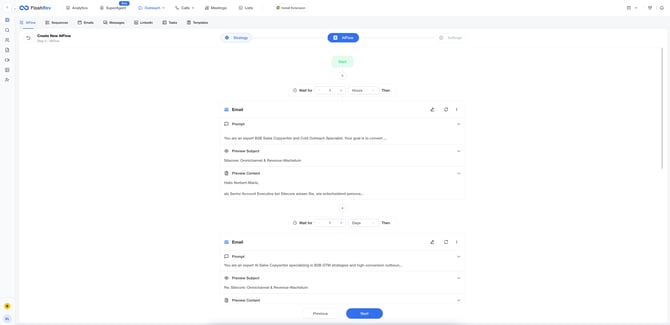
The AIFlow step focuses on multi-stage automated email sequences, utilizing intelligent "Wait" logic to simulate a natural human follow-up rhythm:
-
Multi-Stage Sequence: The flow begins at a Start node and triggers multiple follow-up emails linearly based on preset Wait for intervals.
-
AI Persona & Prompt Modeling: Each email is modeled after a specific AI persona. The first email might be drafted by a "B2B Sales Copywriter Expert," while follow-ups are handled by a "Senior SDR Expert," ensuring a professional and varied tone.
-
Live Preview:
-
Preview Subject: Real-time preview of AI-generated subject lines to ensure relevance.
-
Preview Content: View the actual body text (e.g., "Hello Norbert-Marie...") to confirm dynamic variables and strategy alignment.
-
-
Flexible Control: Every node supports Edit, Refresh, and more, giving users final editorial authority.
Autonomous Settings
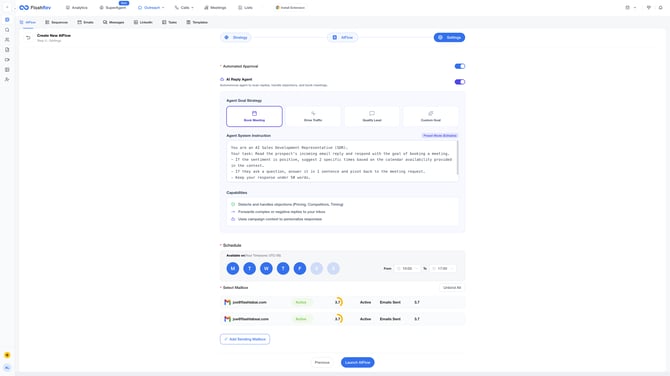
The final Settings step turns your AIFlow into an autonomous sales machine:
-
Automated Approval: When enabled, the system automatically sends AI-generated emails without manual review, drastically increasing outreach scale.
-
AI Reply Agent: Moving beyond just sending, the AI now acts as a true SDR by handling inbound replies:
-
Agent Goal Strategy: Set specific goals such as Book Meeting, Drive Traffic, Quality Lead, or Custom Goal.
-
Agent System Instruction: Define the agent's role. You can instruct it to act as an SDR that suggests meeting times based on a calendar when receiving positive sentiment.
-
-
Precision Scheduling:
-
Timezone Alignment: Set your sending window according to the prospect's timezone (e.g., UTC-5).
-
Business Hours: Choose specific days (Mon–Sun) and precise daily windows (e.g., 10:00 to 17:00) to ensure you hit their inbox when they are most active.
-
This update simplifies every step of the AIFlow journey, ensuring your team can build highly targeted, AI-powered campaigns more efficiently than ever before.
Other
Meeting Router Ad Attribution: Third-Party Tracking Code Injection
Background
Currently, the meeting booking product lacks native ad attribution capabilities. Go-to-Market (GTM) teams, such as sales and marketing managers, are unable to track conversion data within Meta (Facebook) or Google Ads directly from meeting bookings. This gap makes it impossible to accurately optimize ad spend and calculate ROI.
Feature Comparison
Based on the latest update, here is how the experience has evolved:
| Dimension | Before Update | After Update |
| Conversion Tracking | Unable to embed tracking codes on booking pages, resulting in missing conversion data. | Multi-Code Injection Support: Supports third-party scripts including Meta Pixel, Google Gtag, and more. |
| Configuration Flexibility | Limited to a single, fixed confirmation page. | Dual-Scenario Support: Supports code injection on default confirmation pages or attribution via custom URL redirects. |
| Attribution Accuracy | Relies on manual estimation of ad performance and effectiveness. | Native Attribution Support: Automatic event reporting via code, achieving 100% PageView trigger accuracy. |
Conversion Tracking Configuration Panel
We have introduced a centralized management hub for your tracking scripts:
-
Multi-Block Management: Within the Meeting Type editor, users can now add multiple code blocks. Each block includes a Script Name, Head Code, and Body Code.
-
Visual Management Interface: Scripts are organized in a card-style list with intuitive controls for one-click Toggles (On/Off), editing, and deletion.
Injection Logic & Scenario Distribution
To ensure data integrity, the system handles different workflows:
-
Scenario A (Default Confirmation Page): Upon a successful booking, the page automatically loads the user-configured code to execute PageView and conversion event tracking.
-
Scenario B (Custom Redirect): If a redirect to a third-party page is enabled, the system prompts the user to rely on the destination page's PageView for attribution. In this case, internal code blocks will not trigger, preventing data duplication or pollution.
UI/UX Enhancements
-
Developer-Friendly Editor: The code editor now features a Dark Mode (IDE-style) with monospaced fonts for better readability.
-
Contextual Guidance: Integrated Info Boxes provide setup tips, guiding users to correctly configure custom conversions and avoid common pitfalls.
Core Value
-
Marketing Transparency: Empower users to track meeting conversions in real-time within Meta/Google Ads, enabling precise ROI calculations for every dollar spent.
-
Granular Audience Building: Use injected scripts to build custom retargeting audiences based on specific behaviors, such as "Visited Booking Page" or "Completed Booking," to drive higher conversion rates.